


September 22, 2026
What Is Coverage B in Homeowners Insurance? Other Structures Explained for Charlotte Homeowners
Reading Time: 12 minutes
Author: Billy Jordan, President of The Jordan Insurance Agency
Key Takeaways
- Review each detached structure, its use, and the applicable policy provisions before assuming it is covered.
- Read the actual Coverage B limit and compare it with current rebuilding estimates for the eligible property.
- Business, rental, pool, and hardscaping exposures need specific review of restrictions and any exceptions.
- Ask about available higher limits or structure-specific arrangements, including their conditions and effective dates.
- Keep an updated inventory and written answers from your insurer with your policy records.
Understanding Coverage B (Other Structures) on Your Homeowners Policy
Coverage B is the other-structures portion of a homeowners policy. It generally concerns detached improvements on the insured residence premises, such as a separate garage or storage shed. The policy determines which structures qualify, which causes of damage are covered, and how a claim is valued. For a Charlotte homeowner, the practical question is whether the listed limit fits the cost of rebuilding the detached property you actually have, with its current uses disclosed to the insurer.
- Identify each detached structure and how you use it.
- Read the Coverage B dollar limit on your declarations page.
- Check the policy treatment of pools, fences, driveways, and other improvements individually.
- Tell the insurer about business activity or rental use before assuming protection applies.
- Ask about available limit increases or endorsements when the existing allowance is too low.
Billy Jordan has been serving clients since 2006. As President of The Jordan Insurance Agency, he leads an independent team licensed in 23 states.
For property owners across Charlotte neighborhoods like Myers Park, SouthPark, or along Lake Norman, detached improvements often represent substantial investments. Custom guest houses, pool cabanas, decorative brick fencing, and detached multi-car garages can quickly exceed basic policy limits. Verifying how insurers calculate these values and identifying policy exclusions helps North Carolina residents protect their entire residential footprint against severe weather and sudden losses.
What Other Structures Coverage Protects (and What It Excludes)
Start with the definitions in your own policy. A detached garage can present a different coverage question from an attached garage, and a connection such as a breezeway may affect the classification. Ask your agent to identify the applicable provision. Then check the covered causes of loss, exclusions, deductible, and valuation terms. A structure appearing on your property inventory does not establish that every kind of damage to it is insured.
What Coverage B Typically Protects
Use the following as an inventory checklist for a policy conversation. It is not a promise that every listed improvement falls under Coverage B on every form. Record the construction, location, use, and estimated rebuilding cost of each item, then ask the insurer which coverage and restrictions apply:
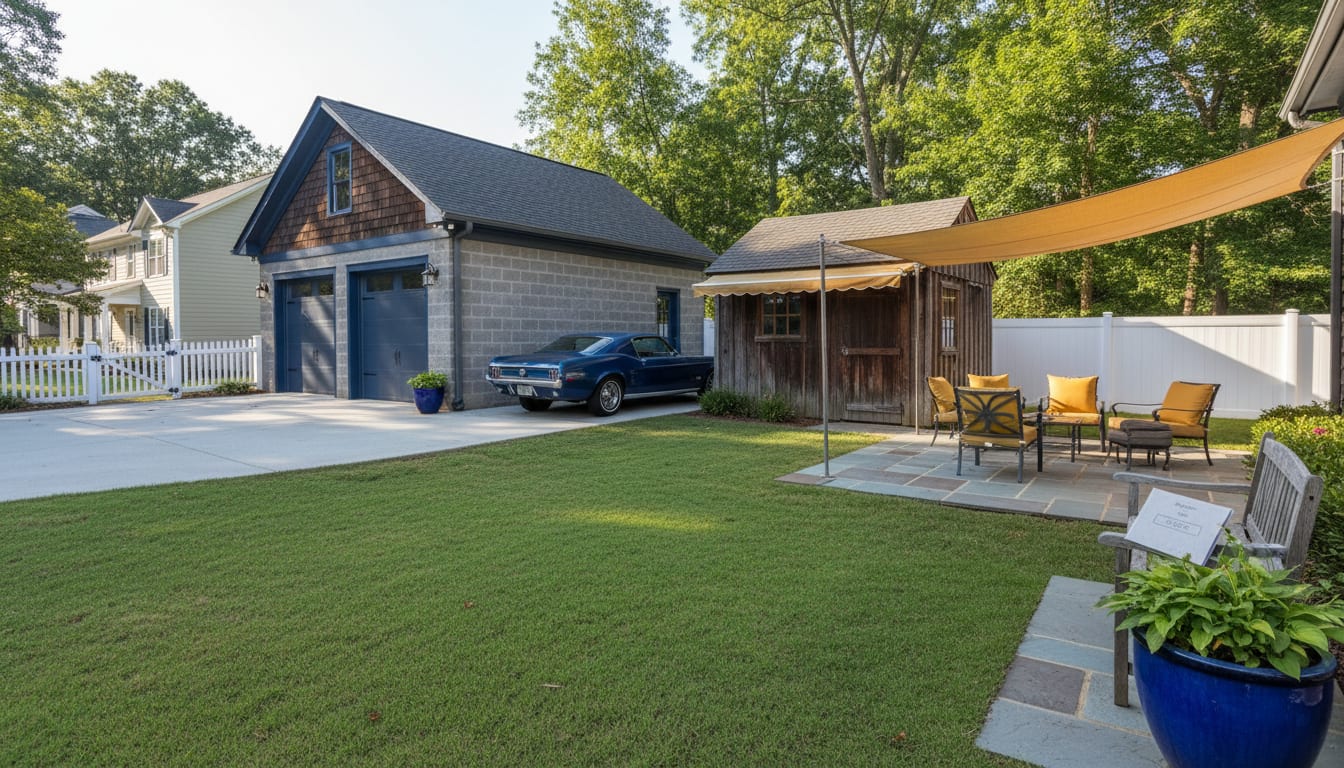
- Detached garages and carports: Describe whether they only store household vehicles or also support another use.
- Storage sheds and barns: Identify their contents and any agricultural or business activity.
- Outdoor leisure structures: Include gazebos, pergolas, cabanas, and freestanding decks.
- Swimming pools: Describe the installation and equipment, then ask about classification and freezing restrictions.
- Boundaries and hardscaping: List fences, retaining walls, gates, and detached patios separately.
- Driveways and walkways: Ask about covered damage and exclusions for settling, wear, roots, and earth movement.
Coverage Exclusions and Restrictions
Coverage B is subject to the written policy, including exclusions and any exceptions to those exclusions. A detached structure used for work or rented to someone else deserves a specific review. Describe what actually happens there; an insurer needs more than the building label to assess the use.
- Business use: Disclose activities, stored inventory, customer visits, and equipment. Ask how the policy defines business use and whether an exception or endorsement applies.
- Rental use: Explain who occupies the structure and under what arrangement. Have the insurer confirm eligibility and any required changes.
- Land and earth movement: Separate the structure from the land and ask about exclusions and any available additional protection.
- Maintenance and aging: Review restrictions for wear, deterioration, settling, and similar conditions. Insurance is not a substitute for maintaining the property.
| Structure or Situation | What to Check | Why It Matters |
|---|---|---|
| Detached garage or shed | Coverage classification, limit, deductible, and valuation | A listed limit does not establish the amount payable for every loss |
| Swimming pool and equipment | Applicable coverage and freezing or maintenance restrictions | The installation and loss circumstances matter |
| Driveways and walkways | Covered causes and exclusions | A sudden event and gradual deterioration raise different questions |
| Detached workspace | Business definition, exceptions, and endorsements | Equipment alone should not be used to assume the coverage answer |
| Rented guest suite | Rental-use restrictions and any permitted exceptions | Confirm the actual arrangement with the insurer |
Bring photographs, dimensions, construction descriptions, and a clear explanation of each building’s use to your review with The Jordan Insurance Agency. Ask the advisor to show where the policy addresses each important item. Keep the insurer’s response with your records, especially when a structure serves more than one purpose. This turns a broad coverage description into specific questions you can resolve before a loss.
How Coverage B Limits Are Calculated for North Carolina Homes
The North Carolina Department of Insurance describes Coverage B as normally limited to 10 percent of Coverage A and notes that additional coverage may be purchased. That is a common starting point, not a substitute for reading your declarations and endorsements. The Insurance Information Institute does not set the terms of your policy; the applicable insurance contract controls.
Read the actual Coverage B amount rather than calculating it from an assumed percentage. Ask whether that amount applies collectively to several structures and whether any structures have separate scheduled limits. When considering a storm that damages more than one improvement, evaluate the combined rebuilding exposure. Keep land value and property sale price separate from the cost estimate used to discuss replacement.
Review tip: Compare your listed allowance with a current, itemized rebuilding estimate. A detached garage, pool cabana, and substantial fencing can create several distinct exposures. Identify any gap using your own property details rather than a claim that the usual percentage is always sufficient or always too low.
Why Default Limits Leave Coverage Gaps
In growing areas across Mecklenburg County, custom outdoor living additions represent substantial investments. Building a detached two-car garage with finished living space, installing an in-ground swimming pool, or constructing extensive decorative brick walls can easily require more capital than a basic percentage allocation provides.
Changes in materials, labor, or the scope of an improvement can make an older estimate less useful. Review the estimate after substantial additions or renovations. Ask whether policy valuation terms, deductibles, or exclusions would still leave expenses even if the stated limit appears sufficient. Increasing a limit addresses the amount of protection; it does not remove every other contract condition.
Increasing Outbuilding Protection With Endorsements
Ask whether your insurer offers a higher other-structures limit or a way to schedule a particular building. Available forms, underwriting requirements, pricing, and eligibility vary. There may be an appropriate adjustment without changing the dwelling limit solely to affect an outbuilding allowance, but the insurer needs to confirm the available option.
- Higher overall limit: Ask whether an endorsement can increase the shared amount for eligible other structures and what additional premium applies.
- Specific structure treatment: Ask whether a high-value building can be listed with a dedicated limit and how that interacts with the remaining property.
- Use-specific coverage: If business or rental activity changes eligibility, ask what form or separate policy would address that exposure.
Reviewing your property layout with an independent advisor confirms whether standard percentage limits protect your outbuildings or if a scheduled endorsement provides better financial security. Homeowners exploring broader protection can review our detailed Charlotte home insurance guide to evaluate comprehensive property coverage options.

Key Coverage B Scenarios: Driveways, In-Ground Pools, Detached Garages, and High-Value Additions
The following are hypothetical situations to discuss with your insurer, not reports of actual client claims or guarantees of payment. For each one, work through the covered property, cause of damage, exclusions, limit, deductible, and settlement terms. Keep any unresolved question on a written follow-up list.
Scenario 1: Storm Damage to a Detached Garage
Mature oak trees line many established Charlotte neighborhoods like Dilworth and Plaza Midwood. During severe summer thunderstorms or winter ice events, heavy branches or entire trees can fall directly onto detached buildings.
If a tree falls onto a detached garage, document the event safely and contact the insurer. Ask whether the cause and damaged structure qualify under the policy, which deductible applies, and how the structure will be valued. Check debris-removal provisions separately rather than assuming that every removal expense is included. A finished upper level or specialized workshop may also affect the description and rebuilding estimate. The insurer evaluates payment under the actual contract and circumstances.
Scenario 2: Hail and Wind Damage to Pools and Fencing
Severe convective storms in the Carolina Piedmont frequently bring hail and strong wind gusts. These weather events can cause extensive damage across outdoor living spaces.
If a storm damages fencing or a pool enclosure, identify the damaged property and ask which coverage applies. Wind and hail treatment can differ by policy and location. For pools and equipment, review freezing, maintenance, and other restrictions separately. Do not treat winterization as the only condition affecting payment. Photograph the installation and keep maintenance information that may help explain the property and the event.
Scenario 3: Backyard Offices and Commercial Activity Exclusions
Many homeowners convert detached sheds, pool houses, or standalone studios into remote workspaces or small business shops. Using an outbuilding for commercial activity creates distinct insurance complications.
Review tip: Describe the workspace accurately before a loss. Storing inventory, seeing customers, or using a building for another business purpose may affect coverage. Ask about the policy’s definition, exclusions, exceptions, and available endorsements. Neither a blanket denial nor a promise that one endorsement fixes every situation is a reliable answer without reviewing the actual use and contract.
High-Value Additions and Specialized Estate Protection
Luxury estates throughout the Charlotte region often feature elaborate exterior installations. Properties with gated entry systems, custom masonry walls, guest houses, detached car barns, and extensive equestrian barns require careful underwriting.
For a property with several substantial improvements, ask for an itemized review of rebuilding estimates and available coverage arrangements. A higher blanket limit or a scheduled approach may be available, depending on the carrier and property. Compare conditions as well as dollar limits. Owners exploring broader options can review our high-value home insurance page and discuss which arrangements fit their property.
Reviewing and Adjusting Your Other Structures Protection with an Independent Agent
Evaluating your property begins with a detailed inventory of every detached item across your residential parcel. Walk your property lines and document each standalone structure, including utility sheds, perimeter fencing, automated driveway gates, freestanding pergolas, and in-ground pool equipment. Taking clear photos and noting recent renovation expenses or custom installations gives your agent an accurate baseline of your true outbuilding replacement costs.
Compare the inventory with the Coverage B line and any schedules attached to your declarations. If the estimates suggest a shortfall, ask the insurer to quote available changes and explain their conditions. Confirm when an accepted change takes effect and retain the revised documents. A request, conversation, or quote alone is not confirmation that the insurance has changed.
An independent agency can help compare the options it represents and explain differences between available forms. Ask which carriers and endorsements are included in the comparison, what remains uncertain, and whether the proposed arrangement addresses your specific uses. Evaluate the overall terms and quoted premium rather than assuming that independence automatically guarantees a lower price or broader coverage.
Protecting detached garages, outdoor leisure spaces, and custom additions requires thoughtful policy design tailored to your specific parcel. At The Jordan Insurance Agency, our team helps homeowners across Charlotte and throughout North Carolina review their policy declarations, calculate accurate outbuilding values, and secure dependable policies. Contact The Jordan Insurance Agency today to schedule a comprehensive property review and request a homeowners insurance evaluation at thejordaninsuranceagency.com.
Frequently Asked Questions
What structures are covered under Coverage B in a home insurance policy?
Coverage B generally addresses detached other structures on the insured residence premises, such as a separate garage or shed. Check how your policy treats each improvement, including pools, fences, driveways, and retaining walls. The classification, use, cause of damage, exclusions, deductible, and valuation terms all matter to a claim.
How is the Coverage B limit calculated on a homeowners policy?
A common starting amount is a percentage of the dwelling limit, but read the actual dollar amount on your declarations and any endorsements. Ask whether multiple structures share that limit and whether any building has a separate schedule. Compare the applicable limits with current rebuilding estimates for your property.
Does homeowners insurance cover damage to driveways and walkways?
Do not assume every kind of driveway or walkway damage is covered. Ask which policy provision applies to the improvement and the cause of loss. Review exclusions for wear, settling, earth movement, and similar conditions. The insurer needs the actual facts before determining whether a loss is payable.
Can I run a business or rent out a detached building under my standard policy?
Business and rental uses can affect eligibility and coverage. Describe the actual activity and occupancy to the insurer, then ask about restrictions, exceptions, and available endorsements or separate policies. Do not assume that equipment alone answers the question or that every rental arrangement receives identical treatment.
How can I increase my other structures coverage if the default limit is too low?
Ask your insurer about available increases or structure-specific arrangements. Provide an inventory, rebuilding estimates, photographs, and accurate use information. Compare the proposed limits, exclusions, premium, and effective date. Keep the revised policy documents after a change is accepted; a quote alone does not establish new coverage.






.svg)
.svg)



